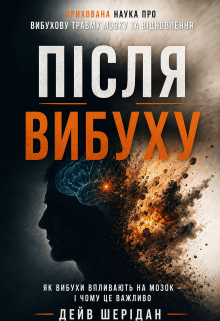
Після вибуху
Джерела
Розділ перший
1. Department of Veterans Affairs, & Department of Defense. (2021). VA/DoD clinical practice guideline for the management and rehabilitation of post-acute mild traumatic brain injury. U.S. Department of Veterans Affairs.
2. Goldstein, L. E., Fisher, A. M., Tagge, C. A., Zhang, X.-L., Velisek, L., Sullivan, J. A., Upreti, C., Kracht, J. M., Ericsson, M., Wojnarowicz, M. W., Goletiani, C. J., Maglakelidze, G. M., Casey, N., Moncaster, J. A., Minaeva, O., Moir, R. D., Nowinski, C. J., Stern, R. A., Cantu, R. C., ... McKee, A. C. (2012). Chronic traumatic encephalopathy in blast-exposed military veterans and a blast neurotrauma mouse model. Science Translational Medicine, 4(134), 134ra60. https://doi.org/10.1126/scitranslmed.3003716
3. Gupta, R. K., & Przekwas, A. (2013). Mathematical models of blast-induced traumatic brain injury: Current status, challenges, and prospects. Frontiers in Neurology, 4, 59. https://doi.org/10.3389/fneur.2013.00059
4. Herculano-Houzel, S. (2009). The human brain in numbers: A linearly scaled-up primate brain. Frontiers in Human Neuroscience, 3, 31. https://doi.org/10.3389/neuro.09.031.2009
5. Hoge, C. W., McGurk, D., Thomas, J. L., Cox, A. L., Engel, C. C., & Castro, C. A. (2008). Mild traumatic brain injury in U.S. soldiers returning from Iraq. New England Journal of Medicine, 358(5), 453–463. https://doi.org/10.1056/NEJMoa072972
6. Phipps, H., Mondello, S., Wilson, A., et al. (2020). Characteristics and impact of U.S. military blast-related traumatic brain injury: A systematic review. Frontiers in Neurology, 11, 559318. https://doi.org/10.3389/fneur.2020.559318
7. Shively, S. B., Horkayne-Szakaly, I., Jones, R. V., Kelly, J. P., Armstrong, R. C., & Perl, D. P. (2016). Characterisation of interface astroglial scarring in the human brain after blast exposure: A post-mortem case series. The Lancet Neurology, 15(9), 944–953. https://doi.org/10.1016/S1474-4422(16)30057-6
Розділ другий
1. Herculano-Houzel, S. (2009). The human brain in numbers: A linearly scaled-up primate brain. Frontiers in Human Neuroscience, 3, 31.
2. Bassett, D. S., & Sporns, O. (2017). Network neuroscience. Nature Neuroscience, 20(3), 353–364.
3. Fields, R. D. (2008). White matter in learning, cognition and psychiatric disorders. Trends in Neurosciences, 31(7), 361–370.
4. Johnson, V. E., Stewart, W., & Smith, D. H. (2013). Axonal pathology in traumatic brain injury. Experimental Neurology, 246, 35–43.
5. Saatman, K. E., Duhaime, A.-C., Bullock, R., Maas, A. I. R., Valadka, A., & Manley, G. T. (2008). Classification of traumatic brain injury for targeted therapies. Journal of Neurotrauma, 25(7), 719–738.
6. Smith, D. H., Meaney, D. F., & Shull, W. H. (2003). Diffuse axonal injury in head trauma. Journal of Head Trauma Rehabilitation, 18(4), 307–316.
7. Menon, D. K., Schwab, K., Wright, D. W., & Maas, A. I. R. (2010). Position statement: Definition of traumatic brain injury. Archives of Physical Medicine and Rehabilitation, 91(11), 1637–1640.
8. Department of Veterans Affairs, & Department of Defense. (2021). VA/DoD clinical practice guideline for the management and rehabilitation of post-acute mild traumatic brain injury. U.S. Department of Veterans Affairs.
9. McInnes, K., Friesen, C. L., MacKenzie, D. E., Westwood, D. A., & Boe, S. G. (2017). Mild traumatic brain injury and chronic cognitive impairment: A scoping review. PLOS ONE, 12(4), e0174847.
10. Giza, C. C., & Hovda, D. A. (2001). The neurometabolic cascade of concussion. Journal of Athletic Training, 36(3), 228–235.
11. Blennow, K., Brody, D. L., Kochanek, P. M., et al. (2016). Traumatic brain injuries. Nature Reviews Disease Primers, 2, 16084.
12. Bigler, E. D. (2013). Traumatic brain injury, neuroimaging, and neurodegeneration. Frontiers in Human Neuroscience, 7, 395.
13. Bazarian, J. J., Biberthaler, P., Welch, R. D., et al. (2018). Serum GFAP and UCH-L1 for prediction of absence of intracranial injuries on head CT. The Lancet Neurology, 17(9), 782–789.
14. Maas, A. I. R., Menon, D. K., Adelson, P. D., et al. (2017). Traumatic brain injury: Integrated approaches to improve prevention, clinical care, and research. The Lancet Neurology, 16(12), 987–1048.
15. Cramer, S. C., Sur, M., Dobkin, B. H., et al. (2011). Harnessing neuroplasticity for clinical applications. Brain, 134(6), 1591–1609.
Розділ третій
1. Courtney, M. W., & Courtney, A. C. (2009). A thoracic mechanism of mild traumatic brain injury due to blast pressure waves. Medical Hypotheses, 72(1), 76–83.
2. Kinney, G. F., & Graham, K. J. (1985). Explosive Shocks in Air (2nd ed.). Springer-Verlag.
3. Cooper, P. W. (1996). Explosives Engineering. Wiley-VCH.
4. Elsayed, N. M. (1997). Toxicology of blast overpressure. Toxicology, 121(1), 1–15.
5. Friedlander, F. G. (1946). The diffraction of sound pulses I. Diffraction by a semi-infinite plane. Proceedings of the Royal Society A, 186, 322–344.
6. Rafaels, K. A., Bass, C. R., Salzar, R. S., et al. (2011). Brain injury risk from primary blast. Journal of Trauma, 71(Suppl. 2), S413–S420.
7. Panzer, M. B., Myers, B. S., Capehart, B. P., & Bass, C. R. (2012). Development of a finite element model for blast brain injury and investigation of intracranial response. Journal of Biomechanics, 45(4), 648–656.
8. Moss, W. C., King, M. J., & Blackman, E. G. (2009). Skull flexure from blast waves: A mechanism for brain injury with implications for helmet design. Physical Review Letters, 103(10), 108702.
9. Fung, Y. C. (1993). Biomechanics: Mechanical Properties of Living Tissues (2nd ed.). Springer.
10. Shively, S. B., Horkayne-Szakaly, I., Jones, R. V., Kelly, J. P., Armstrong, R. C., & Perl, D. P. (2016). Characterisation of interface astroglial scarring in the human brain after blast exposure: A post-mortem case series. The Lancet Neurology, 15(9), 944–953.
Відредаговано: 18.08.2026

Рекомендації книг, Промокоди і Знижки
Підпишись на канал Букнет в Телеграмі і слідкуй за повідомленнями