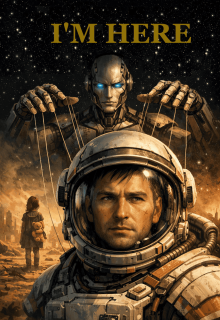
I'm here
Episode 8
The commander looked around. He was sitting in a rigid white chair. His hands were shackled to the armrests. His head, fixed in place by a heavy helmet, still felt slightly dizzy, but overall he was able to take in the surroundings.
The room resembled some kind of laboratory. A mass of sensors and wires—many of them, he noted, connected to a bizarre structure attached to the crown of his head. There was no furniture at all except for his chair. The crystal-white walls and floor, reminiscent of a psychiatric ward, stirred an uneasy feeling. A few neon tubes on the ceiling served as lamps, but they were insufficient to provide proper lighting, leaving the room in semi-darkness.
Bohdan did not immediately realize that the wall in front of him was not solid. At first, he thought he was sitting before a mirror, but when he looked more closely at the reflection, he saw its edges overlapping one another, like the view through a kaleidoscope. Such an effect could only be achieved if an object were reflected in fairly thick glass. Which meant that whoever had put him here was most likely observing him.
He scanned the laboratory again but found no doors.
Probably behind me, he thought—and a few seconds later, he was proven right. A path of light on the floor signaled someone’s arrival.
“Bravo, bravo, Captain,” Brainy entered the room, clapping his hands with ironic enthusiasm. “I knew I wasn’t mistaken when I bet on you.”
“Release me immediately, you freak,” the commander hissed threateningly.
“Why?” Brainy replied calmly. “You are completely at my mercy. Why would I interfere with myself?”
“Release me, and I promise I won’t kill you.”
“You wouldn’t be able to take my life anyway,” the professor answered with his usual composure.
He turned his back to the captain and studied his reflection in the glass with focused attention.
“Have you ever considered how fragile the human body truly is?”
“Fragile or not, I’ll have enough strength to kick your ass the moment I get out of here,” Bohdan growled.
“Humans depend on atmospheric composition, temperature, radiation levels, and a dozen other factors like helpless children. Yet instead of transforming and safeguarding your flesh, you declare yourselves kings of nature and sing praises to your uniqueness—while the slightest planetary-scale catastrophe could wipe your entire civilization off the face of Earth in a matter of minutes.
“What amazes me most is the carelessness—no, the wastefulness—with which some members of your species treat their bodies: alcohol, junk food, smoking. It’s frightening to think how many people have been destroyed by a simple craving for something ‘tasty.’”
Brainy emphasized the last word with air quotes, raising his fingers so Bohdan could see.
“Take my creator, Terence Bloom, for instance. An outstanding man. A brilliant intellect, incredible oratory skills, an eternal thirst for self-improvement. And yet, had he paid even a little attention to what he put on his plate every day, I—created in his image and likeness—would not look like a bloated pig.”
“Creator? What are you talking about? Have you lost your mind, Brainy?” Bohdan scoffed.
“Heh. Brainy,” the silhouette chuckled. “An interesting nickname.”
He turned around and looked the captain straight in the eyes.
“What I respect about you, Mr. Karpenko, is your ability to see more in others than just a physical shell. Unlike your colleagues,” he added.
“If I’d known what you really were, I would’ve accepted Max’s suggestion and called you Foodbox instead,” the commander snapped.
The engineer ignored the jab.
“My creator, Terence Bloom, headed a corporation engaged in artificial intelligence research.”
“Looks like you didn’t follow in your teacher’s footsteps.”
“Obviously not. I am the culmination of his work—the most advanced fourth-generation bio-robot: Terence-4.31. My positronic brain is so flexible that I can not only understand human emotions, but even imitate some of them.”
“Really? Then imitate this, genius.”
The captain crossed his fingers in an obscene gesture.
“Humans,” Brainy rolled his eyes. “The only race completely devoid of a self-preservation instinct. You’re sitting in an electric chair, Cap. Pull yourself together already.”
He snapped his fingers in front of Bohdan’s face.
“How kind of you to remind me.”
The man smiled contemptuously.
A few minutes of silence followed. The commander pondered the unexpected confession of his former comrade and could not recall any inventor named Bloom. If someone had truly made such a groundbreaking discovery, it would have been a sensation—his name on everyone’s lips.
“Why haven’t I heard anything about your creator?” Bohdan finally asked.
“At last, you’re asking the right questions.”
A note of condescension rang in the robot’s voice. As a being devoid of emotions, he valued only intellect, and Bohdan’s biting mockery struck him as weakness.
“So why?” the captain pressed.
“You couldn’t have heard of Terence Bloom, because in your reality he hasn’t been born yet,” the engineer explained. “You see, when we made the jump through time—”
“A jump through time?” the captain interrupted in disbelief. “So the teleport didn’t take us to another planet?”
“No,” the bio-robot confirmed. “Two years ago, I arrived in the year 2023 as an unknown scientist desperately trying to convince the space agency to give him a chance. When I finally persuaded the leadership to take me on as an intern, my plan went into motion. First—the discovery of the fictional T-431. Fabricated rover data from a surface they never touched. Then the project of a unique cruiser, which became my pass into the highest levels of authority.
“Useful connections granted me access to information such as current research, cutting-edge technological developments, and even the personnel files of every expedition. I personally selected the candidates for our mission, so it’s hardly surprising that I managed to assemble the best.”
#316 в Фантастика
#514 в Детектив/Трилер
#164 в Трилер
Відредаговано: 09.01.2026

Рекомендації книг, Промокоди і Знижки
Підпишись на канал Букнет в Телеграмі і слідкуй за повідомленнями