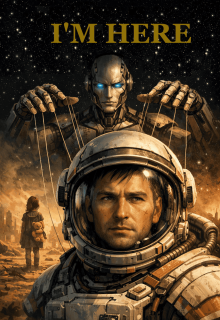
I'm here
Episode 3
The captain and the senior pilot joined the rest of the expedition, who were already savoring the broth. The stewed meat had absorbed the smoke from the fire, acquiring a distinctive smoky taste. Yet this did not make the meal worse; on the contrary, it added a certain piquancy.
“When someone asks me about the tastiest dish I’ve ever had, I’ll confidently point to today’s broth,” Rench said, slurping contentedly.
“To your health,” Max smiled.
“And what about you here, chatterbox? Brainy and I were the ones keeping watch by the fire while you distracted the captain with your chatter.”
“But the idea was mine,” the pilot insisted.
“Show me the chef who feeds guests with ideas,” the engineer who usually stayed neutral on non-scientific matters unexpectedly sided with the mechanic.
“Enough arguing,” the commander said conciliatorily. “The main thing is the result.”
After quenching their hunger and thirst, the travelers began preparing for sleep. Sleeping bags served in place of beds. All expedition members unanimously voted against carrying a tent, as it could significantly slow their progress.
Tonight, the ship’s captain remained on watch, to be relieved by the senior pilot in three hours.
The night was starry and windless. T-431 had no moons, making the darkness around the men seem impenetrable. Only a few charred stalks of tumbleweed and dry roots still smoldered in the fire, but their glow was barely enough for cooking, so the explorers could not rely on them for illumination through the night.
Suddenly, Bohdan heard footsteps behind him. His hand automatically sought the rifle and gripped the stock.
“Can’t sleep?” he recognized the approaching silhouette. “Your shift isn’t for another two hours.”
“It’s just… lonely,” the pilot replied. “No one to talk to before bed.”
“Do you want me to tell you a story?”
“I’ll be fine, you know. Do you see it too?”
A note of unease crept into the pilot’s voice.
“See what?” the captain asked.
“That flickering up ahead,” he said, pointing northward.
“I think it’s a normal atmospheric phenomenon. Light from stars refracts, and it just looks like little lights.”
“In that case, we should feel a temperature change caused by variations in air density.”
“You’re right,” the commander pondered.
“Look!” Max shouted.
The flickering dots drew closer, taking on definite shapes. The astronauts could have sworn there was a city on the hill, the lights they saw nothing less than windows of multi-story buildings. But before they could blink, they found themselves standing beside a narrow street, lost among the small houses of a poor district.
Their attention was drawn to a brick garage that sharply contrasted with the surrounding buildings. It was new and unexpectedly tidy, prompting the explorers to step inside.
All around was dark.
“Hello? Anyone here?” the captain asked as soon as they crossed the threshold.
“Owners!” Max shouted at the top of his lungs.
“Quiet,” Bohdan pressed a finger to the respirator over his lips. “I think I hear footsteps.”
On the glass of the paneled door opposite, a flashlight’s beam reflected.
“I thought there was only one entrance here,” the pilot whispered, just as the doors creaked open with the sound of aged wood.
They did not immediately make out the man who appeared on the threshold, but when he turned on the light, something about him seemed very familiar. The stranger was tall and athletically built, yet his clothing looked somewhat outdated.
The interior was typical of a 1960s auto workshop—shelves lining the walls, numerous toolboxes, and in the corner, jugs of a liquid that smelled like diesel fuel.
In the middle, an old car stood with its trunk open—the pride of a Bavarian motor factory from the early 1950s.
“Rench, hand me the ten-millimeter wrench!” the stranger called, leaning over the battery. “Seems the terminals are corroded.”
“Dad, don’t call me that!”
A tall, thin thirteen-year-old boy entered and handed him the tool.
“Sorry, Henry, but when we work on something together, I always want you involved. Besides, both your grandfather and I had the same nickname.”
The man’s face softened. He looked at his son with affection and added,
“When I’m gone, promise me you’ll continue our family tradition.”
“Do you mean I have to spend my whole life tinkering with this metal junk, like you?!” The teenager kicked the car with all his strength.
“Show some respect, boy.”
The father’s tone, already turning a wrench on the battery terminal, became threatening. Startled by his son’s insolence, he failed to notice he had disconnected the right terminal instead of the left.
“Respect?” the boy sneered. “Unlike you, my peers’ parents care more about their kids than rusty shells.”
“Son,” the man raised his eyes and fixed the youth with a piercing gaze. Resting on the metal trunk wall with wrench in hand, he said, “I…”
But he never finished the sentence. Shocked by the electric current, he collapsed to the floor, writhing in convulsions.
Bohdan and Max, who had stood unnoticed on the sidelines the entire time, rushed to help. And then the vision dissolved like fog. They were back in the desert, and at their feet lay Rench’s lifeless body. The mechanic’s face bore a frozen expression of pain, his scorched fingers still gripping the ten-millimeter wrench.
“What the hell is this?” the frightened lieutenant recoiled.
“Rench! Hey, buddy, can you hear me?” the captain carefully touched his neck, trying to find a pulse.
The pilot looked to his commander, but Bohdan only shook his head bitterly.
“Damn it,” Max cursed. “What’s going on on this planet? Who would want to kill our friend? And what was that weird vision with the garage?”
#308 в Фантастика
#507 в Детектив/Трилер
#157 в Трилер
Відредаговано: 09.01.2026

Рекомендації книг, Промокоди і Знижки
Підпишись на канал Букнет в Телеграмі і слідкуй за повідомленнями