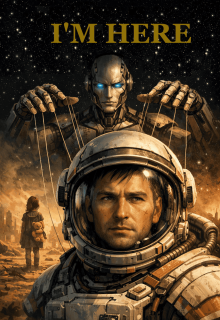
I'm here
Episode 2
The astronauts advanced in a column, keeping a distance of thirty meters between one another. This decision had been made in light of the planet’s unexplored nature and the potential dangers that might lie ahead. In the event of encountering an unknown creature or a ground collapse, the one in the lead would have a chance to warn the others in time.
At the head of the group, naturally, walked the commander. A large, old-school rifle hung from his shoulder—though only in appearance was it such. Long ago, Earthlings had abandoned gunpowder and bullets; a pull of the trigger now released a concentrated energy charge capable of striking and temporarily paralyzing, but not killing, a living being. Such weapons were intended for self-defense rather than attack.
For convenience, the captain had fastened a compass to the shiny leather belt securing his trousers made of dense, waterproof fabric. He checked the direction every hour, as the desert offered no landmarks, and mirages that appeared from time to time only confused the travelers.
Max walked next. He carried the medical kit and jokingly called himself Avicenna, since this gear made him the only professional medic on the entire planet. The lieutenant was not used to walking in silence, and his unceasing tenor was clearly audible to all members of the expedition.
Third came Brainy. Because of his excess weight, the team had decided not to burden him with anything beyond his personal backpack containing water, food, and respirators, which the expedition members had divided equally.
Bringing up the rear was Rench, who, despite countless pleas from his companions, had insisted on carrying along his precious toolbox, hoping to use it in case the rover suffered mechanical damage.
For three hours they walked without stopping. Sweat streamed down their foreheads, sticky rivulets ran along their noses and dripped onto parched lips. As a result, the air inside the respirators felt thick and damp.
The merciless red sun turned the desert into a scorching frying pan. Because of the elevated concentration of carbon dioxide, the horizon was wrapped in a reddish haze.
Rench was the first to falter.
“Maybe we should take a short break?” he suggested, panting from the relentless pace.
The captain turned around. Taking in the sight of his exhausted companions, he reluctantly agreed with the mechanic. They hadn’t even covered a third of the day’s planned route, but ignoring fatigue would have been far more dangerous.
“All right. Let’s take a short rest. We all need to regain our strength.”
“At this pace, no workouts needed,” Max quipped as he spread meat pâté on a rice cake. “We should inform the training center to add walks through scorching deserts to the astronauts’ fitness program.”
“Yeah—and for advanced levels, they should throw in a chatty partner, just to make it the full package,” Rench muttered.
“By the way, I’m the only one trying to entertain us at least a little! Though I admit—it is exhausting.”
He removed his respirator and was about to bite into his sandwich when he suddenly froze.
“Mmm, not bad,” the pilot drawled, greedily inhaling the air. “At first glance, you’d never tell it apart from Earth’s.”
“Oh, does he really have to comment on every single thing he does?”
The mechanic rolled his eyes.
“I strongly advise against neglecting protective equipment,” Brainy interjected. “Prolonged exposure without a respirator causes hallucinations. You could lose consciousness—or even die from oxygen deprivation.”
“The professor has a point,” the captain chimed in, having already been looking for a reason to resume the march. “Let’s not linger.”
“But—”
“You’ll finish it on the way,” he called back to the pilot, already striding off.
By afternoon, the heat began to subside. A light breeze blew from the east, bringing with it long-awaited coolness.
The coast must be nearby, the commander noted to himself as he walked briskly ahead. He recalled last summer—the sea, the gentle whisper of waves washing over golden sand, the cries of seagulls, and the mouthwatering aroma of grilled food drifting from small seaside cafés.
“Buy me another ice cream,” five-year-old Zlata pleaded.
“Sweetheart, you can’t have that much sugar,” her mother worried.
“Buy it, buy it, buy it!” the little girl insisted. “Daddy,” she cuddled up to him like a kitten.
“Mom’s right. It could hurt your teeth, little shark.”
That was the first time she was ever upset with me, the man thought. Firm in her anger, she even refused to go on the rides she’d looked forward to every evening. Strong character, he smiled involuntarily. With a temperament like that, you’ll overcome anything, my girl.
The blood-red sun was nearly touching the horizon when the expedition stopped for the night. They lit a fire and decided to cook broth from stewed meat, emptying the contents of tins into a travel pot.
Burnt and exhausted, the travelers did their best to keep their spirits up. Brainy diligently poked at the sand with the handle of a fork, selecting and sorting small stones of various shapes—likely intending to bring samples from T-431 back to Earth for detailed study.
Rench, as always, fussed over his toolbox. His gaze slid over the metallic curves of wrenches and screwdrivers with the focus of a snake charmer, though his thoughts were far from here. He remembered helping his father fix an old BMW when he was a child, then driving it together to a shabby Brooklyn bakery where the tastiest pies and buns in the suburbs awaited them. His father’s death—whose circumstances he never liked to recall—had turned Rench into a lonely, withdrawn teenager, and something of that boy still lingered within him to this day.
#316 в Фантастика
#517 в Детектив/Трилер
#165 в Трилер
Відредаговано: 09.01.2026

Рекомендації книг, Промокоди і Знижки
Підпишись на канал Букнет в Телеграмі і слідкуй за повідомленнями