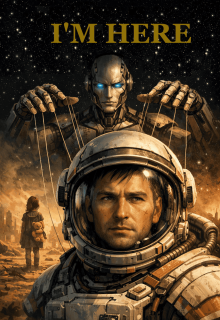
I'm here
Episode 1
The black veil that had long shrouded the mysterious T-431 slowly dissolved under the blinding rays of the local red sun, revealing the planet’s yellow-and-blue face.
According to the onboard computer, the new Earth possessed five continents whose total landmass was one third smaller than that of the travelers’ cosmic home. Moreover, they lay closer to one another, and only in certain areas did their shapes faintly resemble the outlines of Earth’s continents.
The ocean level was higher, and the tallest peaks fell several hundred meters short of Earth’s highest mountains. Most of the land consisted of deserts; scattered green oases appeared only along the coastlines.
The atmosphere contained a slightly elevated level of carbon dioxide, so to prevent dizziness caused by prolonged exposure, the space agency had equipped the crew with respirators, recommending they be replaced every four hours.
Air temperatures at the equator reached fifty degrees Celsius, while at the poles they held steady at –80°C. In the temperate latitudes, a dry continental climate prevailed—the most favorable for the progress of a research expedition. That was why, at six in the morning local time, the captain ordered preparations for landing at the intersection of 49° north latitude and 32° east longitude.
According to data transmitted by the rovers, T-431 might prove to be the cradle of a new, unknown civilization. Nevertheless, not a single instrument had yet managed to detect even the faintest trace of intelligent life on its surface.
Equally strange was the fact that sensors periodically recorded significant fluctuations in the magnetic field, preceded by unusually bright electrical flashes. The most recent of these had disabled one of the mobile research units, making the astronauts’ primary task the retrieval of the rover and the delivery of the collected data back to Earth.
“Check engine readiness,” the captain ordered confidently.
“Energy capacity at eighty-five percent. Fuel level at sixty-three percent,” reported the chief mechanic.
“Life-support system?”
“Stable. Oxygen level twenty-one percent, onboard temperature twenty-two degrees Celsius, atmospheric pressure one hundred and one thousand three hundred twenty-five newtons per square meter,” the chief engineer replied without delay.
“Begin approach. Buckle up, boys,” the captain added less formally as the pilot pressed the Start button on the control panel.
The starship’s crew consisted of four people—handpicked specialists from the United States, Great Britain, and Ukraine. At the head of the team stood the ship’s captain, a brave young man of about thirty who, during his relatively short career, had already visited eight planets of the Solar System, explored the Orion Belt, and crossed the vast Canes Venatici Void twice. The experience gained during previous expeditions had tempered him both mentally and physically.
At the helm was an experienced pilot, the commander’s right hand, nicknamed Max, a name he had likely earned for his ability to give one hundred percent in any situation—whether during complex maneuvers or heated debates. The lieutenant of the Space Guard was notorious for disputes born of his stubbornness, which often ended in dangerous adventures from which he skillfully extricated himself thanks to his professional training.
Since members of the research mission were forbidden to exchange any personal contact information, they could only guess at one another’s real names. To overcome the language barrier, however, the space agency allowed the use of pseudonyms.
When it came to choosing a nickname for the engineer, opinions among the astronauts diverged. Looking at this corpulent gentleman, it was hard to believe he was the very genius who had designed the world’s most advanced intergalactic cruiser. Yet it was precisely his brilliant mind that had turned hyperspace travel from fantasy into reality. So, despite Max’s jabs about the inventor’s excess weight, most of the crew agreed that his extraordinary intellect deserved recognition—and awarded him the nickname Brainy.
The last to join the quartet was the mechanic Rench, who never parted with his tool bag. Although he rarely used most of its contents, his passion for all things metal could not go unnoticed. Wrenches, bolts, and screws were considered relics of the past—echoes of an extensive era of human development when manual labor was still valued. For Rench, they were something akin to a family heirloom, passed down from father to son for generations. A man of few words, he often oiled and polished his tools to pass the time and honor the memory of his ancestors. Even now, as all the astronauts squeezed into their seats with eyes shut tight, hurtling headlong toward an unknown planet, his hands firmly gripped the object closest to his heart.
For a moment, they were blinded by a flash. It was so powerful that even tightly shut eyelids offered no protection, and for several minutes everyone was disoriented.
Max was the first to recover.
“What the hell was that?” he cursed instinctively.
The pilot’s gaze slid to the control panel, and what he saw there openly astonished him.
“Captain, you need to see this,” the lieutenant called out with undisguised alarm.
“Report,” came the commander’s calm reply.
There was no trace of confusion in his voice. The ability to remain cool-headed in critical situations and make measured decisions was precisely what had secured his appointment as captain over Max.
“The instruments are registering significant magnetic field fluctuations near the surface,” the pilot began formally. “Damn it! Cap, the magnetic needle’s gone crazy—it’s spinning like mad!”
“What’s our course deviation?”
“The navigator readings are unstable; the numbers keep flickering. One thing’s clear—we’ve shifted far to the south.”
#308 в Фантастика
#509 в Детектив/Трилер
#157 в Трилер
Відредаговано: 09.01.2026

Рекомендації книг, Промокоди і Знижки
Підпишись на канал Букнет в Телеграмі і слідкуй за повідомленнями