George: The Fall of a Civilization
Chapter 5.
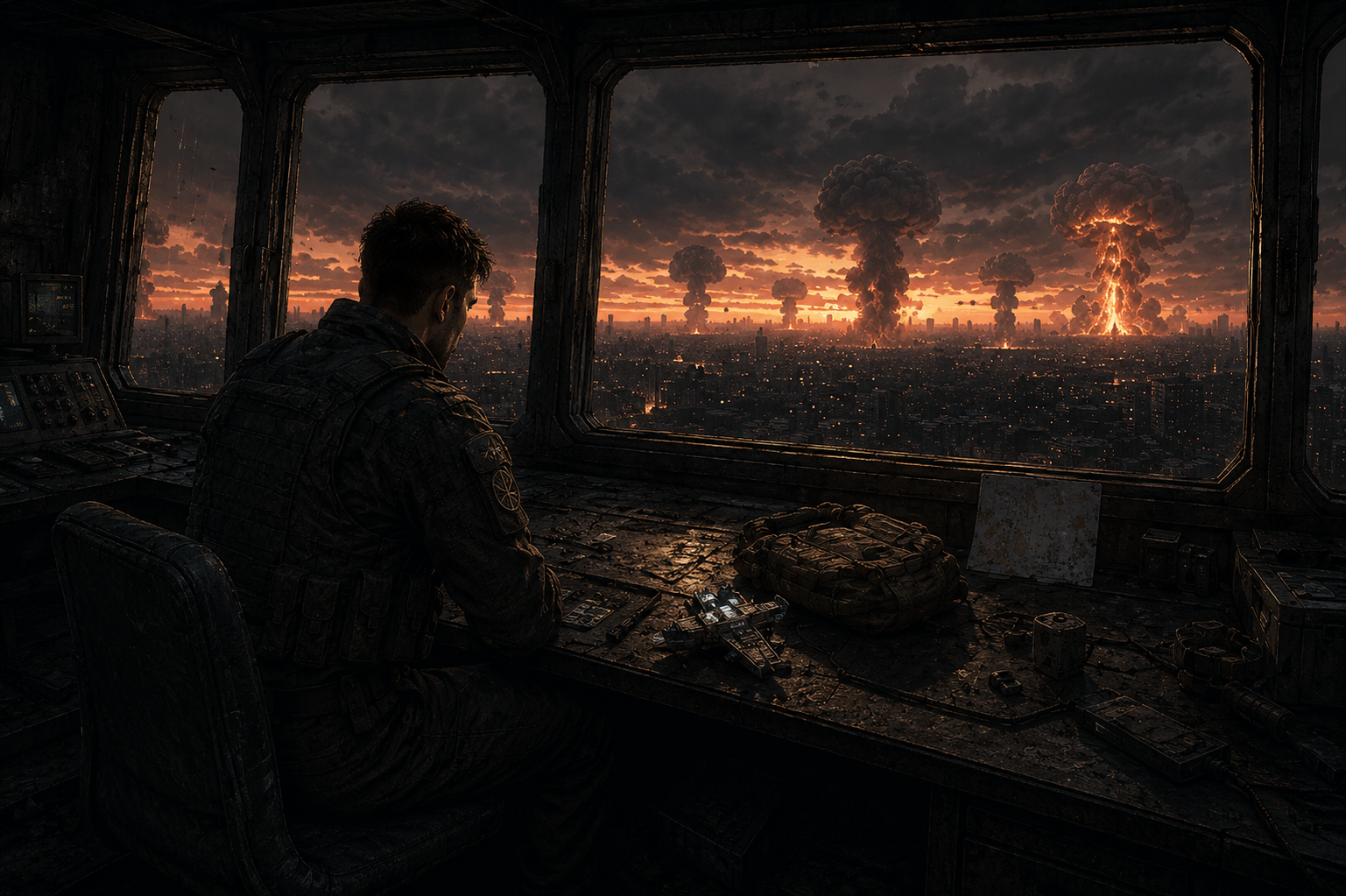
The next morning, the transport hub remained empty. George awoke to a distant rumble and lay motionless for a few seconds, listening. The sound did not repeat, but sleep was gone for good, so he got up, checked his weapon, and left the dispatch center. Nothing had changed overnight. No one had come for help; neither military, nor rescuers, nor Kharakternyks had appeared. The bodies of the dead still lay on the concrete, abandoned machinery stood between the containers, and an unusual silence reigned over the vast complex, broken only occasionally by the wind.
George walked to the edge of the transport hub and stopped by the road leading to the city. The day before, it had been a constant stream of cargo and passenger platforms, but now the wide highway was almost deserted. Here and there, abandoned vehicles stood in the middle of lanes; one had crashed into a barrier, and two more had collided at a nearby intersection. The city itself had also changed. The bright towers that had gleamed in the sun just yesterday were now partially hidden by smoke, and dark plumes rose over several districts. From time to time, a muffled rumble emanated from that direction, and although George couldn't determine its cause from such a distance, he knew the sound too well to mistake it for anything else.
Several times, military aircraft appeared over the city. They passed at high speed, changed course abruptly, and disappeared over the horizon. George watched them, trying to understand what was happening, but even here he saw no system. Once, two jets passed almost on top of each other, and a few seconds later, a bright dot flared high in the sky. One of them began to fall, leaving a black trail behind it, while the other continued its flight as if nothing had happened.
George returned to the dispatch center. Yesterday, he had considered going to the city to find the military, but after what he had seen, the idea no longer seemed wise. He was alone, with a head injury, without a mind-link, and with almost no information about what was happening even a few kilometers away.
The worst part was that he still didn't know who he was supposed to be defending himself from. A person who had been asking for help seconds ago could suddenly try to kill him, and someone who had just been shooting at the unarmed could just as unexpectedly stop. In such conditions, a city of millions was the worst place one could go alone.
Besides, the Kharakternyks knew where his unit had been. If at least one of them had survived, he might return here sooner or later. George decided to wait, using the free time to search the transport hub, gather water, food, and anything else that might be useful. He found an intact first-aid kit, treated the wound on his head, and then spent several hours trying to restore at least one of the communication channels with the military. None responded.
The information network, however, was still functioning, and it was through it that George gradually understood that what he had seen on the transport platform was not an isolated incident. Reports of attacks were now coming from every continent. Military units were losing contact with command or suddenly attacking neighboring units, after which fighting would break out within their own ranks. Fighter jets took off without orders and struck their own bases, air defense systems shot down their own aircraft, and in one metropolis, dozens of passenger platforms simultaneously accelerated to maximum speed and crashed into central stations.
George moved from one report to another, trying to piece them into a coherent picture. He was searching for the same thing he had been searching for since the first minute of the shooting on the platform: an enemy. A sabotage group, an unknown army, at least a direction from which the attack had begun. But the longer he watched, the more obvious it became that there was no conventional logic here. People attacked their own and then became victims of the same kinds of attacks themselves. A unit might capture a military base, but an hour later, its soldiers would start killing each other. Police tried to evacuate civilians until one of the officers suddenly opened fire on their own comrades.
Governments were still trying to control the situation. Officials appeared on screens, declared states of emergency, urged the population to stay home, and assured them that the military was restoring order. George quickly stopped paying attention to these statements. Some broadcasts were cut off mid-speech, and an hour later, a report would come in that the building from which the transmission was being made had been captured or destroyed. No one knew what was happening, but everyone kept talking as if the answer was just around the corner.
On the evening of the second day, George came across a surveillance camera recording from a hospital. At first, he paid it little attention; he had seen dozens of such scenes in the last day. A man attacked medics right in a corridor, acting just like the people on the transport platform—without screaming, without noticeable rage, as if he were simply doing his job. Two orderlies tried to stop him, and during the struggle, he struck his hand against a metal stand, and the bracelet on his wrist shattered into pieces.
George was about to move on to the next report, but something made him linger his gaze on the screen. The man lay on the floor for a few seconds, then slowly raised his head and looked around in confusion. One of the orderlies stepped back, expecting another attack, but the man made no further attempt to strike anyone. He looked at his own hands, then at the wounded medic before him, and the expression on his face changed so drastically that George involuntarily leaned closer to the screen.
#327 в Фантастика
#105 в Наукова фантастика
#109 в Бойова фантастика
Відредаговано: 31.08.2026

Рекомендації книг, Промокоди і Знижки
Підпишись на канал Букнет в Телеграмі і слідкуй за повідомленнями