George: The Fall of a Civilization
Chapter 4.
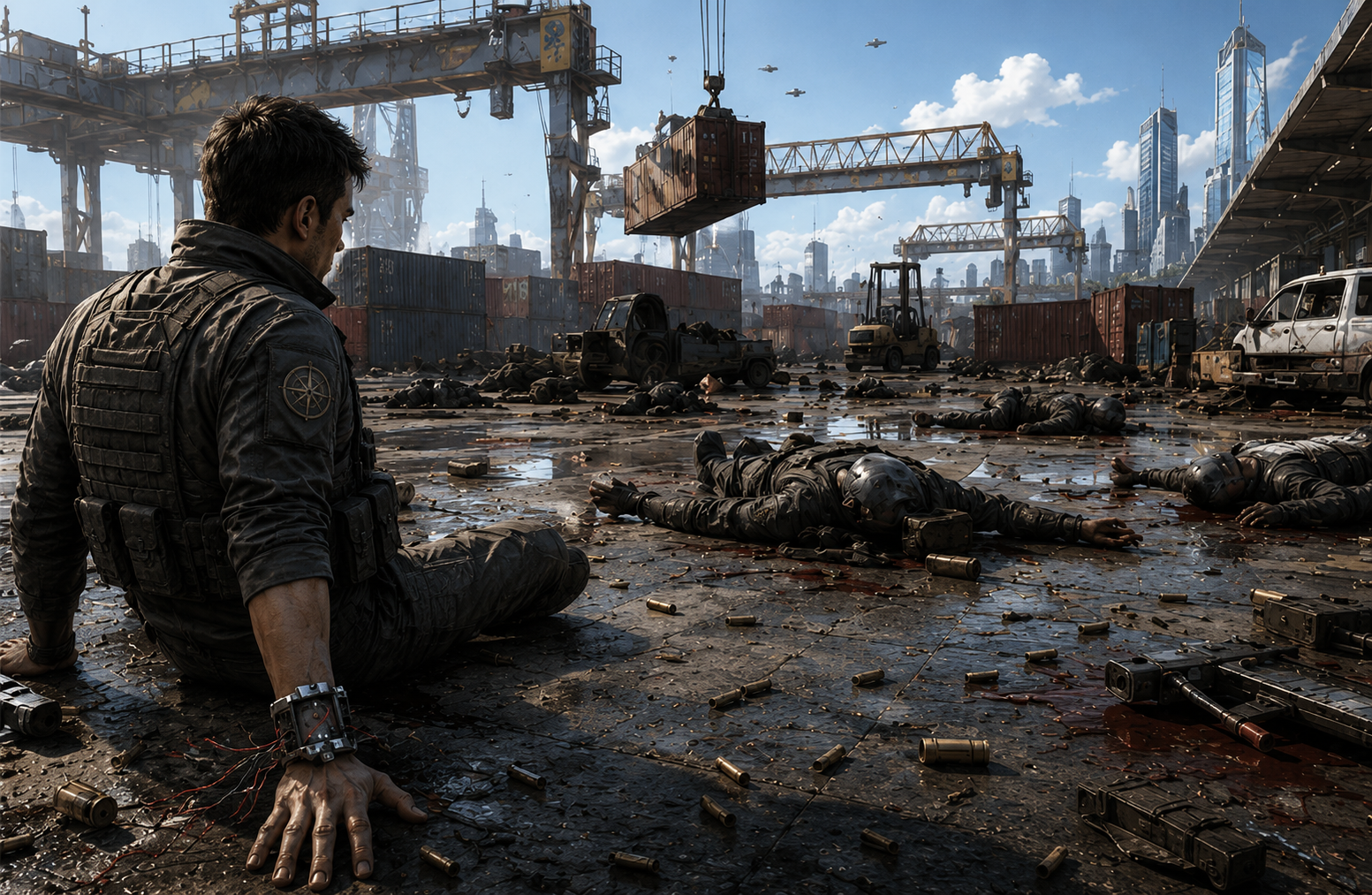
Consciousness returned slowly, as if George were surfacing from a great depth, not understanding where the heavy dream ended and reality began. First, he felt the pain—dull, heavy, concentrated somewhere in the back of his head and so intense that every heartbeat reverberated inside his skull. Then came the sensation of cold concrete against his cheek, the smell of dust, heated metal, and blood. Only then did he dare to open his eyes.
For a while, George just lay there, trying to remember what had happened. The sun, which had been almost directly overhead before the shooting began, had now sunk toward the horizon, and long shadows from the containers crossed the transport platform in dark stripes. So, he had been unconscious for several hours. George carefully pressed his palm against the concrete and tried to get up, but the world immediately swayed, dark spots swam before his eyes, and nausea rose in his throat. He had to freeze for a few seconds, waiting for the dizziness to subside at least a little.
Along with consciousness, memory began to return. The first shot that no one took seriously. The soldier from their unit who suddenly opened fire on his own comrades. People who, for no apparent reason, attacked each other. The Kharakternyks trying to stop a battle that had no enemy and no front line. The last thing George remembered was the wounded man he had rushed to help. The man had raised a weapon, a shot rang out, and then something heavy struck George in the head.
He slowly sat up and touched the back of his head. His fingers immediately found dried blood, but the wound itself seemed to have stopped bleeding. Something else worried him far more: there was an almost complete silence around him. After the chaos that had reigned here before he lost consciousness, it felt so unnatural that George involuntarily listened, expecting to hear at least a distant shot or a human voice. But the transport hub was silent. The automated cranes were frozen above the containers, the cargo platforms no longer moved, and the familiar industrial hum, which had seemed an inseparable part of this place that morning, was gone.
When George was finally able to stand, he was met with a completely different scene than the one he remembered. On the concrete lay bodies, abandoned weapons, scattered tools, and personal belongings. Near the far entrance, several cargo platforms had collided; one of them had tipped onto its side, blocking part of the road. A large container hung motionless under a crane's arm, never having been lowered to the ground. It seemed as if the entire massive complex had stopped in an instant, and then people had simply abandoned it to its fate.
George approached the nearest soldier and knelt beside him. He recognized the man who had been one of the first to start shooting at his comrades. Now he lay motionless, a needle gun lying near his hand. His face showed no fear, no pain, not even the rage George would have expected to see on a man who, just hours ago, had mercilessly killed those with whom he had served for many years. The expression on his face was almost calm, and that made it even more chilling.
After checking for a pulse and finding none, George moved to the next body, then another. There were no survivors among those he found nearby, but he soon noticed something strange: there were far fewer dead than the number of people who had been on the platform before the shooting began. Hundreds of people worked here, not counting the guards and his own unit, but most of the transport hub was now empty. George didn't know where the others had gone. Perhaps they had managed to escape. Perhaps they were hiding in the surrounding buildings or had gone to the city. After what he had seen, he didn't want to consider the other possibility—that those who had survived here had simply carried the madness elsewhere.
Then he remembered the Kharakternyks.
George began to examine the bodies more closely, moving from one to another, searching for the familiar dark armor, but he found none of the three. The Kharakternyks were gone. Even before the shooting started, they had acted as if they sensed approaching danger, and when the chaos erupted, George had seen them trying to stop people and pull out the wounded. If they had managed to survive, they could bring help or at least figure out what had happened. George clung to this thought, though he himself didn't know how realistic it was.
He mechanically raised his left hand, intending to call the commander, and only then remembered his own bracelet. The device, which had simply refused to turn on that morning, was now completely destroyed. The protective casing was cracked in half, several internal components were blackened, and thin wires protruded from under the shattered plate. George tried several times to initiate an emergency recovery, though he knew perfectly well it was pointless, and then lowered his arm in frustration.
Just a few hours ago, a malfunctioning bracelet had seemed like a minor annoyance that would require time for repairs upon his return. Now, George was left without a mind-link, without access to the information network, and without any way to know what was happening even a few kilometers away. He had grown so accustomed to the constant presence of the technology in his daily life that only now did he realize how helpless a person could become when all the information they were used to receiving almost instantly suddenly became unavailable.
#903 в Фантастика
#336 в Наукова фантастика
#193 в Бойова фантастика
Відредаговано: 31.08.2026

Рекомендації книг, Промокоди і Знижки
Підпишись на канал Букнет в Телеграмі і слідкуй за повідомленнями