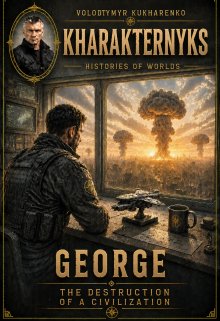
George: The Fall of a Civilization
Chapter 1
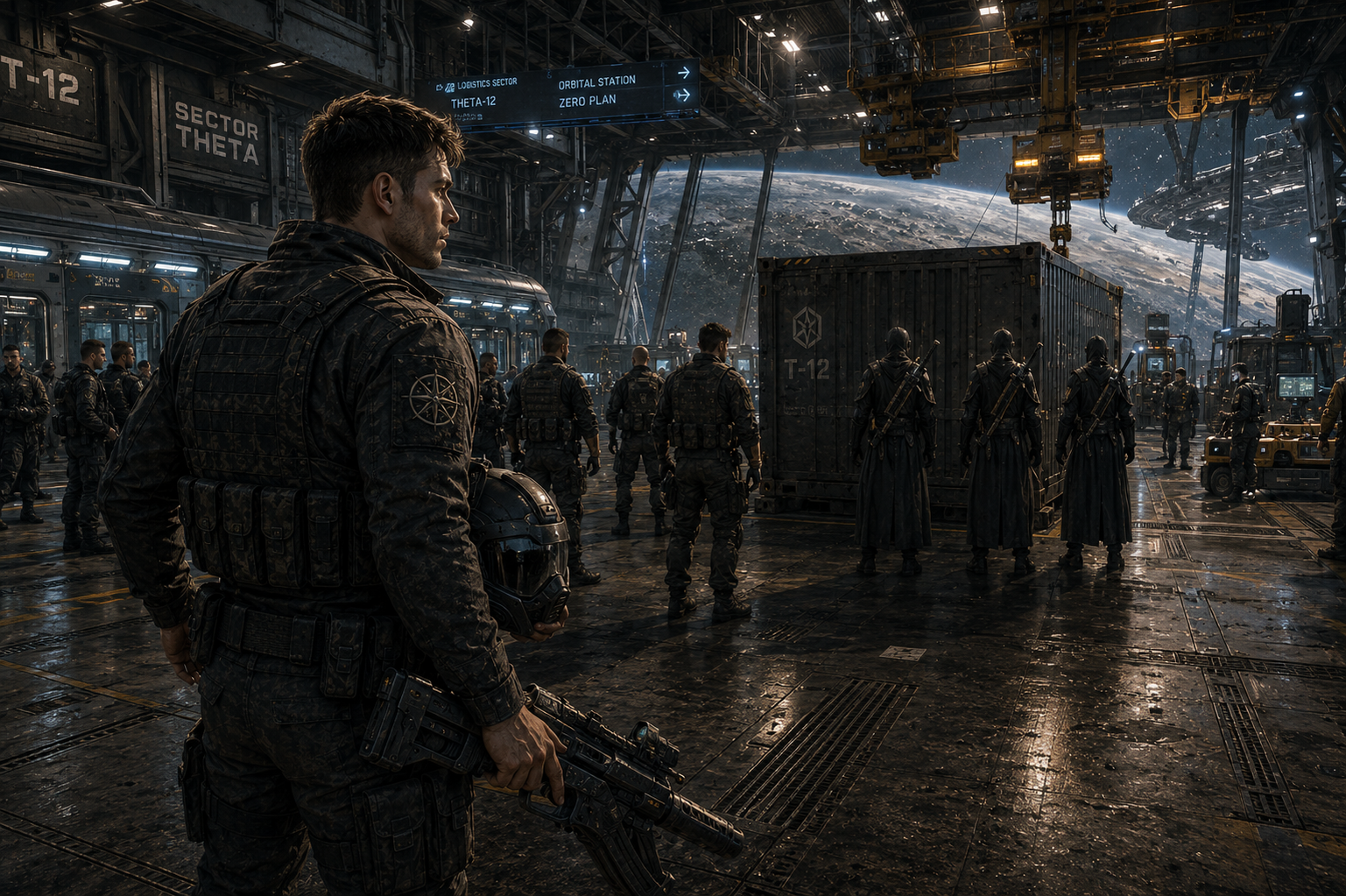
George awoke to a short impulse from his bracelet.
"Unit assembly. Fifteen minutes. Sector Theta. Full combat readiness."
The message vanished almost instantly. He mechanically confirmed receipt, rose from the narrow army cot, and for a few seconds, simply stood by the small porthole of the barracks.
Through the thick armored glass, the surface of the Null Plane slowly drifted by. Even from here, the endless gray expanses, covered in ash and ice, were clearly visible. Life had once thrived below, but after the Great Ash, the planet had never recovered. Sunlight reflected dimly off the frozen plains, over which clouds of dust sometimes rose, and across the entire surface, like arteries, stretched the long ribbons of city-roads that had long become the true home for most of humanity.
George held his gaze on the planet for another moment. He knew the geologists' calculations well. The Earth beneath them was slowly dying. The ancient war had left behind more than just radiation and ash. The tectonic weapons used then had disrupted the very balance of the planet, and now its core relentlessly accumulated tension. Scientists no longer argued about whether a catastrophe would happen. They only argued about whether humanity had three hundred years to find a way to save itself.
That was why expeditions to other planes, which some called parallel worlds or other dimensions, were never just for research. Every new ally, every new technology, every discovery could be another step toward the salvation of all humankind.
It wasn't always this way.
After the Great Ash, humanity lost almost everything it had achieved over the previous centuries. For long years, the survivors had to think not of new discoveries, space exploration, or scientific development, but of the bare necessities: warmth, food, safe shelter, and the chance to simply survive another winter on the war-ravaged planet.
George knew about those times mostly from his parents' stories. They had both survived the final months of the war and what came after in one of the damaged sections of a city-road. The central systems were barely functioning, communication with other sections had long been lost, and supplies dwindled with each passing day. For months, people dismantled abandoned premises in search of anything that could burn, repaired old water purification systems, and shared the remaining food. No one knew if anyone else was alive beyond their section.
His father said that by the end, they had almost stopped waiting for help. People just tried to hold on for one more day, then the next, even though everyone understood that the supplies would eventually run out. It grew colder with each week, equipment failed, and there was often nothing to repair it with. For the first time in the history of civilization, people who had once been capable of building orbital stations and exploring space found themselves facing the simplest question—how not to die of hunger and cold.
And then one day, right in the middle of their section, a portal opened.
A young man emerged from it, whom George's parents had known before the war. Not a close friend or a relative—just a familiar face from a life that now seemed almost unreal. They had seen him often before and could never have imagined that he, of all people, would one day return to them from another world.
He turned out to be a Kharakternyk.
Like many others, the awakening of his power had thrown him far from home, to one of the alien planes. He was luckier than most: the Null Plane was relatively close, and the young man quickly learned to control his ability and open portals. Fate had scattered other Kharakternyks much farther—tens, and sometimes hundreds, of planes away from their home world. Some perished without ever finding their way back. Some remained to live in the world they had been cast into. And some spent years moving from plane to plane, gradually getting closer to home.
That young man was just one of those who managed to return.
First, he found a few groups of survivors, then he began to search for others. People gradually gathered around him, just as they did around other returning Kharakternyks in different parts of the planet. Communication was restored between isolated settlements, it became possible to cross territories that were previously impassable, and portals opened up access to resources and knowledge that were almost gone from the devastated Earth.
Over the years, more and more Kharakternyks returned. They came by different paths and brought with them knowledge of the worlds they had visited. Their return became one of the main factors that helped the scattered groups of survivors feel like part of a single civilization again.
For George's parents, it was all much simpler. They remembered to the end of their days the moment a portal opened in the dark corridor of a half-dead city-road and a familiar young man stepped out. Until that moment, they were almost certain that their world was ending with them. After it, for the first time in many months, there was hope that a future still existed beyond their section.
The revival of the Null Plane took decades. Humanity gradually rebuilt what was lost, restored and expanded the city-roads, returned to orbit, and regained its ability to look to the future. Contact with other planes accelerated this process, providing access to new knowledge and technologies, but perhaps the main change wasn't even that. After years when each group of survivors thought only of the next day, people began to believe again that their civilization would have a next day at all.
#904 в Фантастика
#335 в Наукова фантастика
#194 в Бойова фантастика
Відредаговано: 31.08.2026

Рекомендації книг, Промокоди і Знижки
Підпишись на канал Букнет в Телеграмі і слідкуй за повідомленнями